The Twin Loft Bed With Desk, Taken Apart Piece by Piece
 Head of Design·June 25, 2026·22 min read
Of everything we make at DICTAC, the twin loft bed with a built-in desk is the product people ask me about most, and it is also the one that most rewards a close look. On a product page it is a photo and a bullet list. In a real bedroom it is the difference between a child who does homework on their bed because there is nowhere else, and a child who has an actual desk, in a room that never had space for one. That gap between "a bed with a desk under it" and "a workspace a small room could not otherwise hold" is the whole story, and it is worth telling slowly.
This is a piece-by-piece breakdown of the frame: the thinking behind the layout, every measurement that actually matters, what the storage really holds, how the assembly goes, the gaming variant, and, the section I insist on including, who should not buy it. I designed this bed, so I am not a neutral party, but I would rather you buy the right frame for your room than the wrong one from us. Let us take it apart.
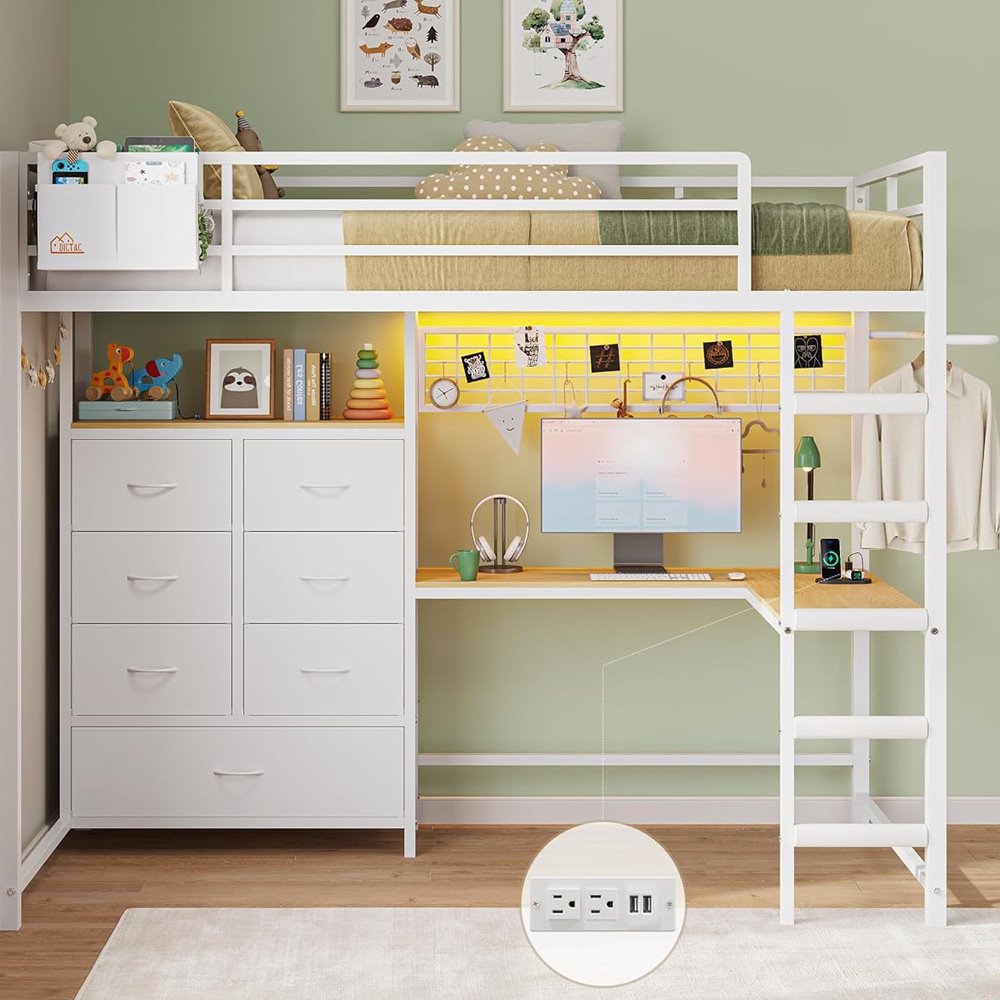
Twin Loft Bed with L-Shaped Desk & 7 Storage Drawers
The subject of this article: a twin loft bed with an L-shaped desk, seven fabric drawers, an open shelf, a pegboard, an LED strip and a charging station — a bedroom and a study in one footprint.
View details & specs →The idea: why a loft bed with a desk exists at all
Every bed has a volume of air above it that does nothing. In a small room, that dead air sits on top of the single most valuable thing you do not have: floor. The loft bed's entire premise is to swap them: lift the sleeper up into the dead air, and hand the reclaimed floor to something useful. On this frame, that something is a complete workstation, an L-shaped desk, seven drawers, an open shelf and a pegboard, so the space under the bed is not just clear, it is a study.
The reason we build the under-space out so fully, rather than leaving it open for the customer to fill, is that a half-solved problem is barely solved. A bare loft with nothing underneath asks you to go and buy a desk and a dresser and then fit them in, which reintroduces the exact floor problem the loft was meant to fix. By integrating the desk and storage into the frame, the bed arrives as a finished solution: one purchase, one footprint, one assembly, and the room is done. That integration is also why the loft bed is often the best-value furniture in a small room, a point I made in our comparison of bed types: you are not buying a bed, you are buying a bed plus a desk plus a dresser, and paying roughly the price of one.
The layout, zone by zone
Look at the frame as three zones stacked and folded into one footprint: the sleep zone on top, the work zone below, and the storage wrapped around the work zone. Each was designed against a specific real-world frustration.
The sleep zone. A full twin sleeping platform up top, with a full-length guardrail so a sleeper cannot roll off at height, and a fixed ladder to reach it. The platform sits on a supportive base, no box spring needed, and the guardrail height is set to clear a mattress of normal depth while still doing its job. This is the simple part, and it is simple on purpose: the clever engineering is all below.
The work zone. An L-shaped desk is the heart of the lower level, and the L is not a style choice — it is the shape that gives you the most usable desktop in a corner while leaving the rest of the under-space for storage and legroom. An L-desk lets a monitor or a laptop sit on one arm and leaves the other clear for writing or spreading out a project, which a single flat desk in the same space cannot do. A built-in power strip sits within reach so a laptop, a lamp and a phone all have somewhere to plug in without an extension lead snaking across the floor.
The storage zone. Seven fabric drawers, an open shelf and a pegboard wrap the work zone. The drawers handle the things that need to be hidden: clothes, supplies; the open shelf handles the things you reach for often; and the pegboard handles the things that never have a home, from headphones to medals to fairy lights. The point of offering three kinds of storage rather than just a pile of drawers is that a real desk has real clutter, and clutter sorts itself far better across the right mix of drawers, shelves and hooks than into drawers alone.
An L-shaped desk isn’t a styling flourish. It’s the single shape that gives you the most usable desktop in a corner while leaving the rest of the under-bed space for storage and your knees.Daniel Hu, Head of Design
The measurements that actually matter
Product pages list a lot of numbers; only a few of them decide whether a loft bed will work in your room. Here are the ones I would check, and why each one matters more than it looks.
Ceiling clearance for the sleeper. This is the make-or-break number. The person sleeping on top has to be able to sit up in bed without their head near the ceiling. Take the height of the sleeping platform and add a sitting adult or child, plus a little clearance, and compare it to your floor-to-ceiling measurement. If you are tight, this frame is the wrong one for the room, full stop. A bed you cannot sit up in is a daily misery no amount of storage redeems.
Desk clearance underneath. The headroom at the desk decides whether the work zone is genuinely usable for the person who will sit there. For a child it is ample for years; for a tall teenager or adult it is the second number to check after ceiling clearance, because a desk you have to stoop into is a desk that does not get used.
Overall footprint and swing space. The assembled length and width tell you if it fits the floor, but the number people forget is swing space: the room a drawer needs to open, the space the ladder occupies, the door that must still clear the frame. The most common avoidable disappointment with any bed is one that fits the floor but blocks a door or a drawer once built. Measure the swing, not just the footprint.
Guardrail height. At height, the guardrail height relative to the mattress depth is what matters: too thin a mattress and the rail feels high, too thick and the rail's protection shrinks. The product page gives the guardrail height; match it to a normal-depth mattress and it does its job.
| Measurement | Why it decides the purchase | What to do |
|---|---|---|
| Ceiling clearance | Top sleeper must sit up comfortably | Platform height + sitting person vs your ceiling |
| Desk headroom | Decides if the work zone is usable | Check against the person who’ll sit there |
| Footprint + swing | Fit the floor AND clear doors/drawers | Measure swing space, not just footprint |
| Guardrail height | Safety at height | Pair with a normal-depth mattress |
| Weight rating | Confidence in the sleeping platform | Look for a specific, tested figure |
What the storage really holds
Seven drawers, an open shelf and a pegboard sounds like a lot, and it is, but the useful question is what it replaces. In practice this frame absorbs the storage of a small dresser and a desk organiser combined. The seven fabric drawers are enough for a child or teenager's entire clothing rotation plus school or hobby supplies; the open shelf takes the books, the speaker, the things in daily reach; the pegboard, with its S-hooks, becomes a vertical catch-all that keeps the desktop clear, which is the real secret to a desk staying usable, because a clear desktop is a used desktop.
The drawers are fabric on a frame rather than solid boxes, which is a deliberate trade-off: they are lighter, they will not jam or swell, and they keep the whole piece from becoming a monolith, while still hiding clutter completely. For heavier, permanent storage, a full bookcase, a wardrobe's worth of folded clothes, you would pair the loft with a dedicated storage piece, and because the loft freed up the floor, you now have somewhere to put one. That is the loft's gift that keeps giving: it does not just store things, it creates the floor space for whatever storage it cannot itself provide.
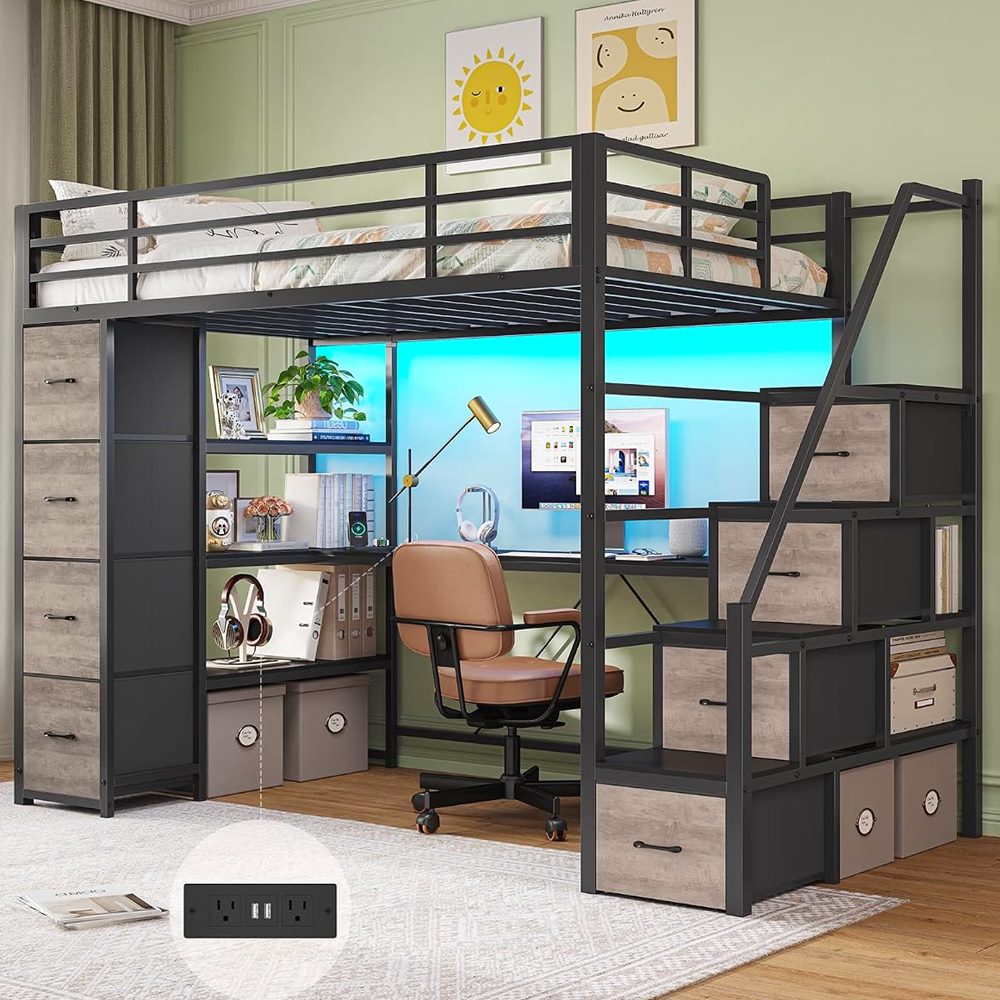
Twin Loft Bed with Storage Stairs & 8 Drawers
Prefer stairs to a ladder and even more storage? The staircase loft trades the fixed ladder for wide steps that are themselves drawers, plus eight drawers in total: the same idea with a different access-and-storage balance.
View details & specs →Assembly: what building it is actually like
A loft bed is one of the more involved flat-packs to assemble, and I would rather set an honest expectation than a flattering one. Plan on one to two people and around ninety minutes, and strongly prefer two — not because one person cannot do it, but because holding the upper frame steady while you bolt it is much easier with a second pair of hands, and safer.
The build goes better if you respect a few things we learned from watching our own team assemble sample units, which is exactly the test-build stage I am always going on about. Lay out and identify the numbered hardware before you start, so you are not hunting mid-step. Leave every bolt finger-tight until the whole frame is together, then tighten in sequence, tightening too early fights you when the next part needs to align. Build it close to where it will stand, because a finished loft is heavy and awkward to move. And use the included anti-tip kit; a loft bed is tall, and anchoring it is not optional. The instructions are printed, illustrated and, because our test builders flagged the confusing steps before this frame ever shipped — genuinely followable. The single most important after-step is to re-torque the main bolts a week later, once the frame has settled, which is the difference between a loft that stays silent and one that develops a creak.
The gaming variant, and other members of the family
The L-desk loft is the workhorse, but it has relatives worth knowing about, because the right one depends on what the desk is for. If the person using it games, the gaming loft with an L-shaped desk and a glass display cabinet is built around that use: more desktop for multiple monitors, cable management thought through for a gaming rig, RGB lighting to match the setup, and a glass cabinet to show off the things gamers like to show off. It is the same core idea — bed up, workspace down, tuned for a specific person.
At the other end, if you want the loft's floor-reclaiming trick with a lighter storage load and a cleaner price, the L-shaped desk loft with three drawers keeps the desk and the essential storage without the full seven-drawer wall. And if the sleeper is younger, the low loft with a play space lowers the whole thing to a child-appropriate height and swaps the desk for a hidden play nook. Same family, same philosophy, matched to different people and rooms, which is exactly how I would want you to choose, by the person and the room rather than by the photo.
| Variant | Best for | What changes |
|---|---|---|
| L-desk, 7 drawers | Teen/adult needing max storage | Full storage wall + pegboard |
| L-desk, 3 drawers | Lighter needs, cleaner price | Desk kept, storage trimmed |
| Gaming loft + glass cabinet | Gamers | More desktop, RGB, cable routing, display |
| Low loft + play space | Younger children | Lower height, play nook instead of desk |
Who should not buy this bed
I promised this section and it matters. A loft bed with a desk is a brilliant answer to a specific problem, and a poor answer to problems it was not built for. You should probably look elsewhere if:
- Your ceiling is low. If the top sleeper cannot sit up comfortably, no amount of storage saves it. Measure first; if you are tight, a platform bed gives you storage without the height.
- The sleeper is a very young child. High lofts and ladders are for older children and up. For a little one, a low kids' bed or the low-loft variant is the correct product, not a compromise.
- You do not actually need a workspace. If the room has floor for a bed and you have nowhere you need a desk, the loft adds a climb and a ceiling constraint for a benefit you will not use. A platform bed will serve you better.
- Two people need to sleep there. A loft sleeps one. For two, you want a bunk bed, which solves the two-sleeper version of the same space problem.
If none of those apply, if you have a single sleeper, a small room, a reasonable ceiling and a genuine need for a desk, then this is very likely the highest-impact piece of furniture you could put in that room, and I say that as the person who has watched it transform hundreds of them.
I’d rather you buy the right frame for your room than the wrong one from us. A loft with a desk is transformative for the right person and a daily nuisance for the wrong one, so be honest about which you are.Daniel Hu, Head of Design
The maths: one loft bed versus three separate pieces
I keep asserting that a loft bed with a desk is often the best value in the room, so let me actually show the working, because it is the argument that most changes how people see the price. When you buy this frame you are not buying a bed. You are buying the functions of three separate pieces of furniture, a bed, a desk, and a dresser, plus the thing none of them come with: the floor space to put all three.
Price a small room the conventional way and you buy a twin bed, then a desk with drawers, then a chest of drawers, and then you try to fit all three onto a floor that, in a small room, cannot take them. Something ends up on the bed, or against a door, or not bought at all. The loft bed collapses those three purchases into one object in one footprint, and the footprint is the one the bed was going to occupy anyway. So the honest comparison is not "this loft bed versus a cheaper plain bed". It is "this loft bed versus a bed plus a desk plus a dresser plus a bigger room to hold them." On that comparison the loft is routinely the cheapest path to a functioning small bedroom, not the most expensive, which is the exact point I made about value in the bed-type comparison.
| Conventional room | What it costs you | Loft-bed room | What it costs you |
|---|---|---|---|
| Twin bed | Money + floor for a bed | Loft bed with desk | Money + floor for a bed |
| Separate desk | More money + more floor | Desk | Included, uses no extra floor |
| Chest of drawers | More money + more floor | 7 drawers | Included, uses no extra floor |
| A bigger room | The biggest cost of all | , | Not needed |
Choosing a mattress and bedding for a loft bed
A loft bed changes two practical things about mattresses and bedding, and getting them right makes the difference between a bed that is a pleasure and one that is a daily fiddle. First, depth. Because the guardrail protects to a fixed height, the mattress depth matters more than on a normal bed: too thick and the rail's protection shrinks below where you want it at height; too thin and the rail feels awkwardly tall. A standard-depth twin mattress is the sweet spot, and I would steer away from the very deepest pillow-top mattresses on any lofted sleeping surface for exactly this reason.
Second, weight and making the bed. A loft is made up in the air, reaching over a guardrail, so a mattress you can actually handle matters. A moderate-weight foam or hybrid twin is far easier to wrestle a fitted sheet onto at height than a heavy traditional innerspring. Many owners keep bedding simple on a loft for the same reason: fewer layers, a duvet rather than a tightly tucked top sheet, so that making the bed each morning is a ten-second job and not a gymnastic one. None of this is a drawback of the loft so much as a small set of choices that, made well once at purchase, you never think about again. It is the kind of thing our support team is happy to talk through if you are unsure what your mattress depth will do to the guardrail.
Safety at height, in detail
Because this bed puts a sleeper up high, safety deserves more than a passing line, and it is something we design for deliberately rather than bolt on. Three things do the work: the guardrail, the ladder, and the anchoring. The full-length guardrail runs the open side of the sleeping platform and is set at a height that, with a normal-depth mattress, keeps a sleeper safely contained, including the restless kind who move a lot in their sleep. The ladder is fixed, not loose, with rungs positioned for a secure climb, because a ladder that shifts is a ladder that causes falls.
The anchoring is the part people are most tempted to skip and should not. A loft bed is tall, and like any tall piece of furniture it must be secured against tipping. Hence an anti-tip kit ships in the box as standard and why our build process treats it as part of the product, not an accessory. Fit it. It takes minutes and it removes the one genuinely serious risk a tall frame carries. Beyond the hardware, the age guidance matters: high lofts are for older children and up, not for toddlers, and the low-loft variant exists precisely so that younger children can have the same idea at a safe height. Safety on a loft bed is not a single feature; it is a guardrail, a solid ladder, an anchored frame and the right age of sleeper, working together.
Living with it, long term
The last thing worth covering is what owning this bed is like over years, not weeks, because a loft bed is a long-term relationship with a piece of furniture. The maintenance is minimal and the same as any of our frames: wipe it down, re-torque the main bolts a couple of times a year, keep an eye on the drawer glides and give them a touch of dry lubricant if they ever drag. Do that and the frame stays silent and solid for a decade: we build these to the standard laid out in our materials guide, with powder-coated steel and cycle-tested glides, precisely so that "years of daily use by a teenager" is a design assumption, not a stress test.
What changes over time is not the bed but the person using it. A loft bed bought for a twelve-year-old's homework becomes a sixteen-year-old's study-and-social space and then a college packing list. The desk that held school books holds a laptop and a coffee; the pegboard that held medals holds cables and lanyards. That adaptability is designed in, the zones do not care what you put in them, and it is why a loft bed tends to earn its keep for far longer than the room it first solved. When it is finally outgrown, a well-made frame has resale or hand-down life left in it, which is the most sustainable end an object like this can have, and a theme we keep returning to across the blog.
A day in the life of this bed
The best way I know to explain why the layout works is to walk through a normal day with it, because a loft bed with a desk is not really furniture. It is a small routine you live inside. Morning: the sleeper climbs down the ladder, and the bed is out of the way for the whole day rather than dominating the room the way a floor-level bed does. Getting dressed happens at the seven drawers, which hold the full clothing rotation, so there is no separate dresser to cross the room to. School or work bag gets packed from the open shelf and the pegboard, where the things you grab on the way out, headphones, keys, a charger, live at eye level instead of migrating to the floor.
Afternoon and evening: the under-bed zone becomes a study. The L-desk gives room for a laptop on one arm and a book or notepad on the other; the built-in power strip keeps everything charged without a cable crossing the floor; the LED strip lights the work surface directly. Homework, gaming, drawing, video calls. The desk is a real desk, not a corner of a bed, and that distinction changes how much actually gets done there. Night: the sleeper climbs back up behind the guardrail, and the room below is a clear desk and a tidy floor rather than a bed filling the space. The same square metres did the work of a bedroom, a study and a dressing area across one day, which is the entire promise of the design made concrete. Multiply that by a few thousand days and you see why this is the frame I am proudest of.
A loft bed with a desk isn’t really furniture — it’s a small daily routine you live inside. Bed up and out of the way by day, a real desk underneath, a clear floor to stand on. The same square metres, three times over.Daniel Hu, Head of Design
How it compares to the alternatives you’re weighing
If you are looking at this bed, you are probably also looking at a few alternatives, so let me be straight about how it stacks up against each, because the right answer genuinely depends on your situation and I would rather you get it right.
Versus a plain bed plus a separate desk. If your room has the floor for both, separates give you flexibility to rearrange and to replace one without the other. If it does not, the usual reason people look at a loft, separates simply will not fit, and the loft wins by default because it puts the desk in space that would otherwise be dead air. Floor is the deciding factor.
Versus a bunk bed. A bunk sleeps two; this sleeps one and gives that one a workspace instead of a second sleeper. If you need two beds, a bunk is the answer; if you need one bed and a desk, this is. They solve different versions of the space problem, as I laid out in the bed-type comparison.
Versus a platform bed with storage. A platform bed gives you storage and a normal, no-climb bed, but no workspace and no reclaimed floor. If you do not need a desk and your ceiling is low, the platform is the calmer choice. If you need the desk, only the loft delivers it. It comes down to whether "workspace" is on your list.
| You’re choosing between | Pick the loft-with-desk if… | Pick the other if… |
|---|---|---|
| Loft vs bed + separate desk | The floor can’t hold both | The room has space for separates |
| Loft vs bunk bed | One sleeper needs a workspace | Two people need to sleep there |
| Loft vs platform bed | You need a desk / more floor | No desk needed, or low ceiling |
Frequently asked questions
What size mattress does it take, and is a box spring needed?
It takes a standard twin mattress and needs no box spring: the sleeping platform has a supportive base built in. Use a normal-depth mattress so the guardrail sits at the right protective height; a very thick mattress reduces the effective guardrail height, and a very thin one makes the rail feel high.
How much weight does the top bunk hold?
The sleeping platform carries a sleeper comfortably within its rated figure, which comes from a load test rather than a spreadsheet, as we explain in our production walkthrough. The specific rating is on the product page; if you need it confirmed for a heavier sleeper, our support team will give you the exact number.
Can an adult use this, or is it just for kids?
Adults use it very happily, provided the ceiling gives enough clearance to sit up in bed and the desk headroom suits their height: the two numbers to check in the measurements section above. It is a genuinely popular choice for students and small-room adults, not only children.
Is it noisy or wobbly at height?
Not if it is assembled properly and maintained. The frame is welded steel engineered against racking, and the trick to keeping it silent is the one-week bolt re-torque after it settles, then a check twice a year. A loft that develops a wobble is almost always a loft whose bolts were never re-tightened, not a design fault.
Where do I buy it and see the full specs?
The product page has the complete specifications, the full image gallery and the buy option, and you can see the whole family in the loft beds collection. For the wider range, start at the full catalogue or the DICTAC homepage.
Daniel Hu
Head of Design · DICTACPart of the team behind DICTAC’s space-saving beds and storage. Read more about how we work, or browse the full range.